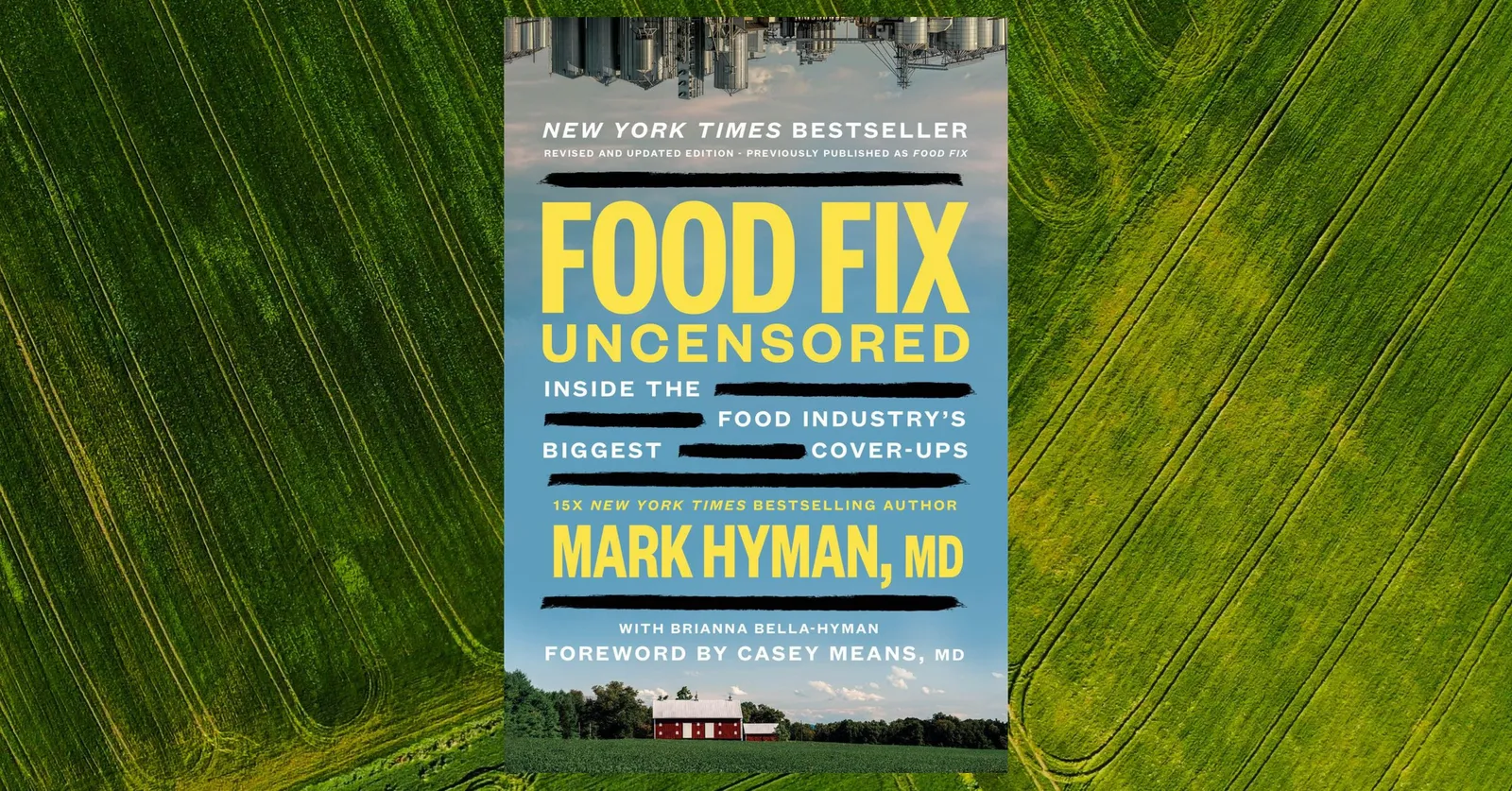
I just finished reading Mark Hyman’s new book, Food Fix Uncensored: Inside the Food Industry’s Biggest Cover-Ups. It’s an amazing book. I’ve known about the link between sugar and chronic disease for a long time, but even I was shocked by what I learned. I recommend you read and share this book with your family, your friends, and everyone in your network — regardless of their political leanings.
In this blog, I’ll talk about some of the concepts covered in Mark’s book and what actions we can take to rebuild a food system that prioritizes health over profit.
The Scale of The Problem & What It’s Costing Us
Look at photos of people at the beach from the 1960s and you'll see a mostly lean population. Obese children were rare. Today, according to the Centers for Disease Control and Prevention (CDC),74% of American adults are overweight or obese, and nearly 20% of our children are obese.[1] Fourteen percent of adults have type 2 diabetes, 40% have insulin resistance, and 40% have metabolic syndrome — numbers that climb even higher after age 60. [2,3] Perhaps most alarming: 71% of young Americans are currently ineligible for military service due to poor health.[4]
These aren't just personal health statistics — and they're not the result of personal failures, either. They're the predictable outcome of a food and agricultural system designed around corporate profit, not the health of American people. And it’s expensive: according to the CDC, chronic disease and mental health conditions now account for about 90% of America's nearly $5 trillion in annual healthcare spending.[5]
Hyman’s book lays it out like this — Big Food, Big Ag, and Big Pharma engineer, market, and profit from the products and policies that drive the development of chronic disease. And the costs of chronic disease land on us — the patients, the families, the employers, and the taxpayers.
That trajectory is not sustainable — and as Hyman makes clear, it didn't happen by accident.
How We Got Here
This was a new term for me – commercial determinants of health (CDoH). It is defined by the World Health Organization (WHO) as “private sector activities that affect people’s health, directly or indirectly, positively or negatively.” Among other things, that includes the ways Big Food, Big Ag, Big Alcohol, and Big Tobacco target children and vulnerable communities to manufacture demand for (and addiction to) many of the products linked to chronic disease.
Hyman traces the acceleration of this influence to a Supreme Court ruling that determined a corporation’s financial contributions to political campaigns were protected by the first amendment. This opened the floodgates for corporate money in politics at both state and federal levels. The result, he argues, is a government that increasingly protects the interests of large corporations over the interests of the people it supposed to be serving.
And he's careful to point out that this isn't a partisan problem. Both parties have taken the money, and both parties have protected their donors.
How Big Food Captured the Institutions That Were Supposed to Keep It in Check
Starting in the 1960s, which accelerated in the 1980s, the tobacco industry began acquiring major food companies one by one. They brought into the food companies their decades of expertise in engineering addiction and dodging regulations — and they put it to work. Using food scientists, neuroscientists, and functional MRI technology, these companies reverse-engineered the precise combinations of sugar, salt, and fat that produce maximum pleasure in the brain when the food item was consumed. Then they marketed those products aggressively to children, low-income communities, and communities of color. Big Tobacco eventually spun off the food companies in the early 2000s, but the damage was already done, and the strategies to create addicting foods haven’t changed.
That playbook now extends well beyond the grocery store. Big Food money flows into political campaigns, which influence who gets appointed to lead and then staff agencies like the Food & Drug Administration (FDA), National Institutes of Health (NIH), and the US Department of Agriculture (USDA) — the agencies responsible for our health, food, and agricultural policy. Appointees like the Secretary of Health and Human Services and the Secretary of Agriculture and their high-level staff frequently come directly from Big Food and Big Ag. Hyman argues it's naïve to assume they leave their former employers' interests at the door, and when you look at the policies that result, it's hard to disagree. This happens under both Republican and Democratic administrations.
Who Can You Even Trust?
The corruption doesn't stop at government. It runs straight through the organizations most Americans rely on for unbiased health guidance.
The American Heart Association (AHA) and American Diabetes Association (ADA) both accept significant funding from Big Food — and both allow their trusted logos to appear on food products for a fee, regardless of whether those products actually support better heart health or optimal blood sugar management. A product can be loaded with added sugar and still carry an ADA or AHA logo. The Academy of Nutrition and Dietetics (AND), the premier organization for registered dietitians, not only accepts Big Food money but has allowed food industry representatives to present at their annual conferences and teach dietitians. And at the land grant universities where most dietitians are trained, Big Ag and Big Food are major funders of the research being conducted and the dietetics departments— which raises real questions about what's being studied, and what's being taught.
The reach extends to advocacy organizations as well. Big Food has donated millions to the NAACP and the Hispanic Federation — the same communities their products most aggressively target. Black and Hispanic Americans have significantly higher rates of obesity and diabetes than white Americans, in large part because these communities have been deliberately and aggressively marketed to since childhood. When lawsuits attempted to introduce sugar taxes that might have helped, Big Food successfully solicited friend-of-the-court briefs from those same organizations to fight them. And when the NAACP and Hispanic Federation have tried to host educational programming about the harms of added sugar and ultra-processed foods, Big Food has blocked it.
Predatory Marketing and the Countries Pushing Back
We don't allow tobacco or alcohol companies to market their products to children. So why do we allow the same aggressive tactics from an industry selling food products consistently linked to higher risk of developing obesity and diabetes?
Other countries have decided they won't. Chile was among the first to act — and it wasn't easy. Big Food successfully blocked initial reform efforts, but Chilean voters responded by electing officials willing to stand up to industry pressure. The result was strict limits on marketing to children under 14, paired with a simple, mandatory, front-of-package labeling system: green, yellow, and red indicators showing whether a product is high in added sugar, salt, or saturated fat. No fine print. No confusion. Other countries across Latin America, as well as Canada, Mexico, and parts of Europe, have followed with similar reforms.
The US has not.
The System Is Rigged Against Accountability
Part of the reason for this is that Big Food has spent decades building legal protections for itself. Lawsuits against tobacco companies and opioid manufacturers have ultimately been successful in changing behavior and influencing public policy. Big Food has watched and learned.
Multiple states have now passed laws that prohibit suing food companies for creating addictive products linked to obesity and type 2 diabetes. Others have granted immunity to pesticide manufacturers for cancer-related lawsuits — even as Bayer has paid over $11 billion in Roundup-related cancer settlements as of early 2025.[6] A proposed Farm Bill would extend that shield federally. And Ag-Gag laws — which criminalize undercover investigations into food safety, worker safety, and environmental violations — have been passed in multiple states, including here in Iowa.
This isn't a broken system. It's a system working exactly as designed — just not for us.
What You Can Do About It
The good news is that change is possible. We've seen it happen in other countries, and we're starting to see early signs of it here too. Politicians who have accepted Big Food and Big Ag money are beginning to feel pressure from their constituents to change course.
Hyman's ask is simple: contact your elected officials at both the state and federal level. Pick one issue, make your case, and ask for a written response. Do it again and again asking the elected officials to respond your issues, one by one. When you're evaluating candidates, look at who's funding their campaigns — because that will tell you whose interests they'll protect once they're in office. We can all demand better from our elected officials in government.
If you want a roadmap, pick up the book. Hyman covers far more than we've touched on here — the connection between food and mental health, between food and violence, the hidden potential of healthy soil, and the pilot programs already showing what's possible when policy actually serves people and the farmers (as opposed to agrichemicals corporations).
As Margaret Mead reminded us, most meaningful change starts with a small group of committed people deciding enough is enough. That group can include you.
I invite you to be part of the small group of people demanding we address Big Food-driven corruption in our government and begin enacting policy changes that support our health and our economy.
Citations
- Obesity and Overweight. Fast Stats. National Center for Statistics. CDC. https://www.cdc.gov/nchs/fastats/obesity-overweight.htm.
- Childhood Obesity Facts. CDC. February 2024. https://www.cdc.gov/obesity/childhood-obesity-facts/childhood-obesity-facts.html
- National Diabetes Statistics Report. CDC. January 2026. https://www.cdc.gov/diabetes/php/data-research/index.html
- Unfit to Serve. CDC. February 2024. https://www.cdc.gov/physical-activity/php/military-readiness/unfit-to-serve.html
- Fast Facts: Health and Economic Costs of Chronic Conditions. Chronic Disease. CDC. January 2025. https://www.cdc.gov/chronic-disease/data-research/facts-stats/index.html
- Gillam C. Bayer wins preliminary court approval for its proposed Roundup class action settlement. March 4, 2026. https://www.thenewlede.org/2026/03/bayer-wins-preliminary-court-approval-for-its-proposed-roundup-class-action-settlement/